
Interview Dr. Beatriz Diez for Ciencia en Chile.
A group of researchers from Chile is studying at more than 4,200 meters above sea level different viruses in the water of the geysers of the El Tatio geothermal field, in the Andes Mountains, in the middle of the Atacama Desert.
Lorenzo Palma, Science in Chile. Every year the El Tatio geothermal field is visited by more than 100,000 tourists, but scientists also arrive. They have been sampling the area for several years, but currently they are carrying out a Fondecyt research, which brought together a group of national researchers, led by Dr. Beatriz Diez, from the Faculty of Biological Sciences of the Pontificia Universidad Católica de Chile (PUC), together with Diego Morata; Carla Barbosa, a master’s student from the Faculty of Physical and Mathematical Sciences of the Universidad de Chile (UC) and Dr. Raquel Quintrini from the Fundación Ciencia y Vida of the Universidad de San Carlos de Chile (UC), and Dr. Raquel Quintrini from the Fundación Ciencia y Vida of the Universidad de San Carlos de Chile (FSC). Raquel Quintrini of the Science and Life Foundation of the Universidad San Sebastián (USS), to study viral communities and their interactions with potential hosts in the El Tatio geothermal field, located 89 km from the town of San Pedro de Atacama.
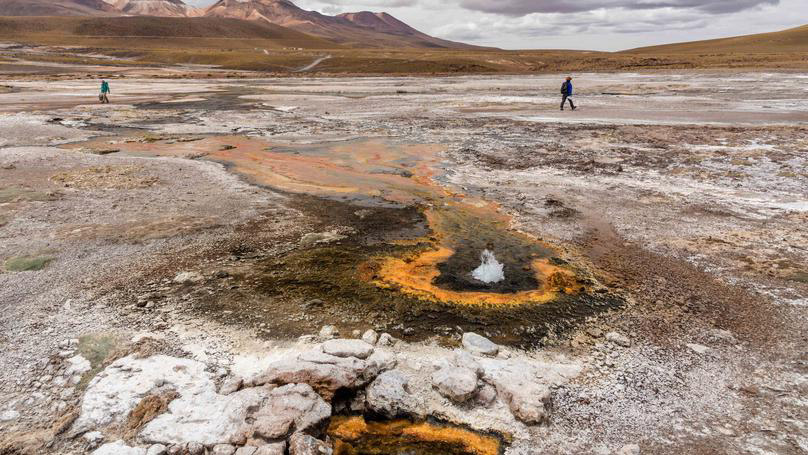
El Tatio has more than 200 geysers, fumaroles and thermal pools, scattered over an area of up to 30 km2, making it the largest geothermal field in the southern hemisphere and the fourth largest in the world. The environmental conditions in which it is located are extreme, due to its elevation above 4000 m.a.s.l., its scarce precipitation, high UV radiation and the daily thermal oscillations of up to 35°C to which it is subjected. The microbial communities that exist in this geothermal field have evolved in isolation for thousands of years, and present high rates of endemism worthy of study to better understand the trajectories of the evolution of life on Earth and eventually on other planets such as Mars, say the researchers.
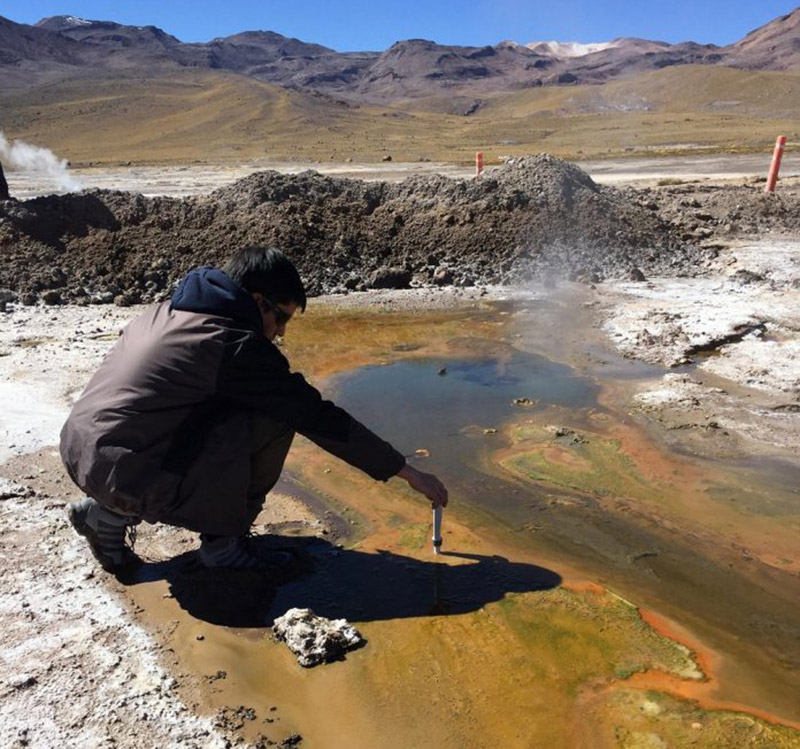
When Dr. Díez visits El Tatio, she gets as close as possible to the boiling waters of the different geysers that exist in the geothermal field in order to understand the effects of environmental variables, such as temperature and pH, as well as to understand how the differences between viruses will be between one geyser and another more distant one. All this, they say, will help them to catalog viral biodiversity and dynamics under the particular environmental and geological conditions that exist in El Tatio.
“At this time, when the world is in check by minimal and invisible components such as the SARS-CoV2 virus, and the Covid-19 disease they cause, the importance and the need to obtain more and better information on the diversity, identity, function and activity of viruses in nature becomes evident. Without this information it is difficult to generate the necessary knowledge to be prepared and anticipate their impacts on human health or our environment. For various reasons, many viruses that do not have humans as their usual host are becoming an important public health problem,” explains the researcher.
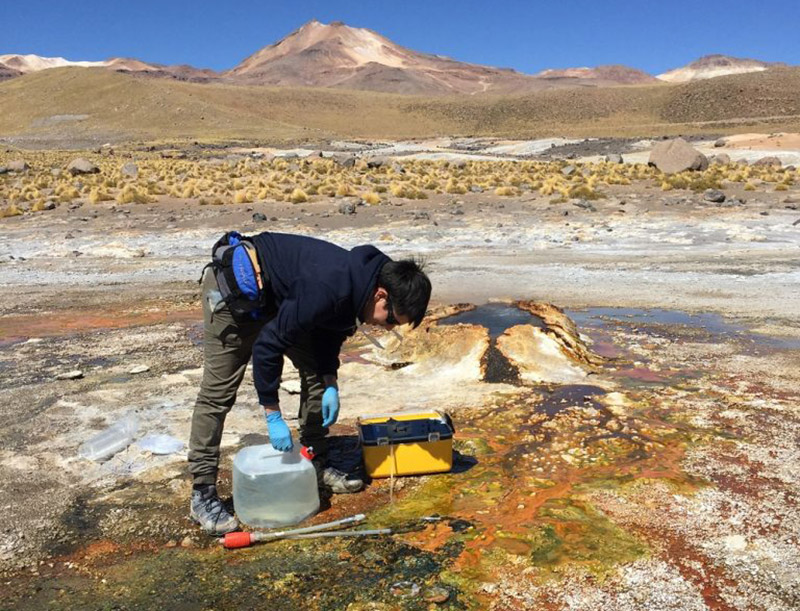
The work team began the second year of four, in the framework of the Fondecyt Regular project (N°1190998). To date, they have managed to find and georeference more than 20 hot springs with similar physical-chemical and geological conditions, with splendid microbial mats growing in them, a precondition to be selected and sampled. “This, together with the fine-tuning of some sampling and sample processing methodologies, will now allow us to carry out the work planned in some of the objectives set out in the project. With the pandemic we could not finish our first year’s sampling and it will be necessary to wait until we can travel again to obtain samples from all the hot springs found that meet the necessary conditions for the study,” explained the director of the research.
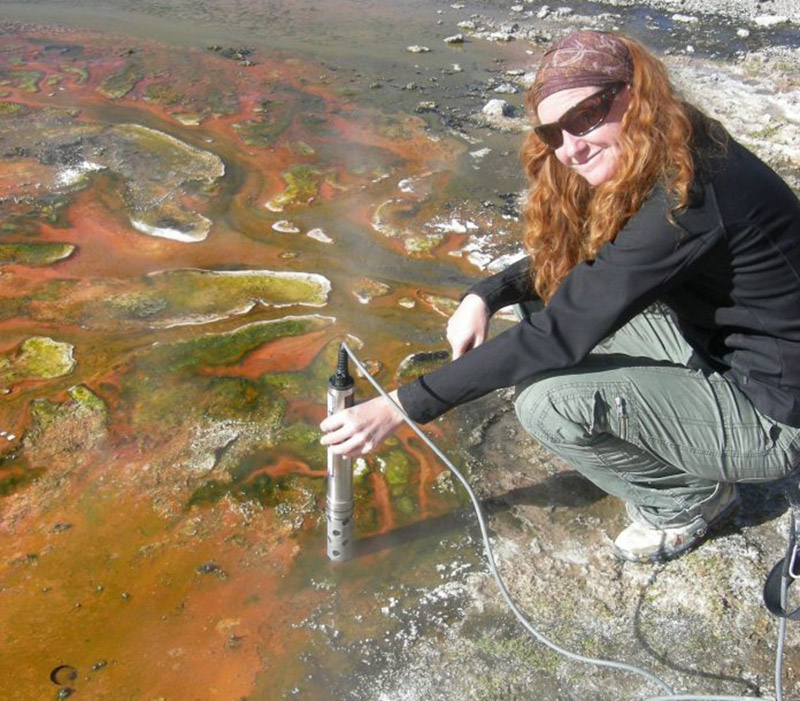
This research stands out for being the first that has studied native microorganisms associated with an environment as particular as El Tatio, and it is also the first comprehensive study of viral ecology in microbial mats, which are real carpets of organisms, in this case of terrestrial hot springs.
When you visit El Tatio you will observe that some geysers are painted between orange and green, and this coloration is not casual, but the result of the interaction of autotrophic organisms, which form microbial carpets, which is not always easy to find and that hide a totally new diversity. Viruses are found right there, and they do not exist if they do not have a host, therefore, there are bacteria and archaea, which are unicellular and filamentous prokaryotic organisms. A whole world to discover, say the specialists, of which very little is known in the case of viruses, how do they function and evolve under these extreme conditions? These will be questions that will be further explored over the next three years.
The researchers say that they want to contribute to form a repository of scientific knowledge of the area, but also cultural knowledge for Chile and the world, “which can also help the native communities to achieve better management and conservation of the park. Hopefully, at some point the El Tatio geothermal field will be named a World Heritage Site,” concluded Dr. Beatriz Diez.
You can also read the interview in its original format in Science in Chile.