
Interview Dr. Beatriz Diez for Ciencia en Chile
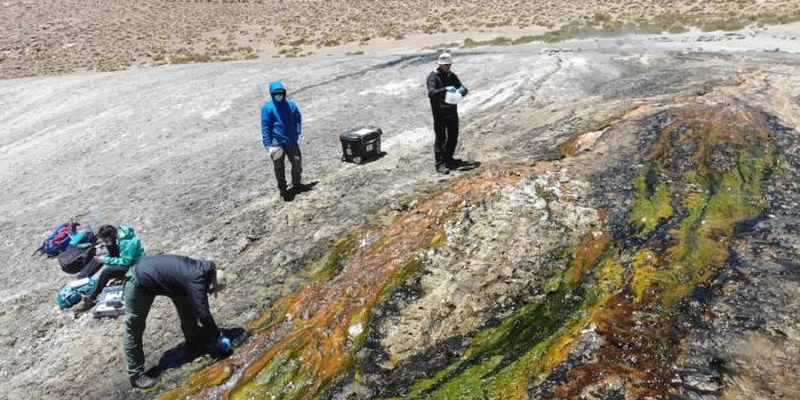
At 4,200 meters above sea level and during 9 days, a group of researchers focused on taking samples in 13 geysers of the El Tatio geothermal field, in the Atacama Desert.
Lorenzo Palma, Science in Chile. Every year more than 100,000 visitors arrive early in the morning, when the sun has not yet appeared in the Andes Mountains. They make an effort enduring the cold, the puna and getting up early to see some of the 40 geysers or 60 hot springs and 70 fumaroles that form the complex. They say that it is best appreciated before sunrise to see how the water emerges at 90 degrees Celsius and at an impressive and dangerous pressure.
El Tatio is, along with Yellowstone in the United States and Kamchatka in Russia, one of the three largest geothermal fields in the world. But El Tatio is only 100 km from San Pedro de Atacama in Chile.
El Tatio, or grandfather who cries as it is known in Kunza, holds the record as the largest geyser complex in the southern hemisphere. It also stands out for its low rainfall, high UV radiation and daily temperature fluctuations of up to 35°C.
The microbial communities that exist in this geothermal field have evolved in isolation for thousands of years, and could present high rates of endemism worthy of study to better understand the trajectories of the evolution of life on Earth and eventually on other planets, is what Dr. Beatriz Diez of the Faculty of Biological Sciences of the Catholic University of Chile says.
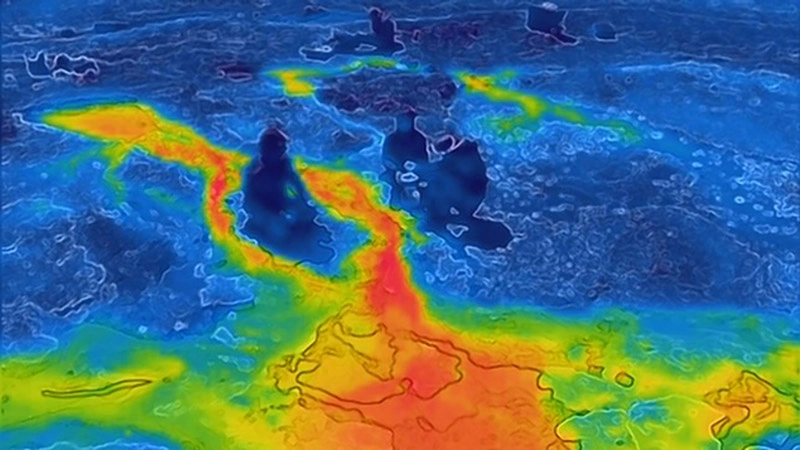
This place tests ecological theories, such as the relationships between viruses and their hosts, explains the researcher of the Catholic University. The interest in having samples from the 13 hot springs was to find sites with similar characteristics, both in terms of salinity, pH and temperature. One of the questions raised was: If all the environmental conditions are the same in the hot springs, will we find the same living organisms in them?
The group then also questioned whether, given the existence of similar conditions in the hot springs, are there different viruses or are they the same ones that infect the same communities of living organisms that inhabit them? Dr. Díez explains that it is important in ecology to understand if it is true that everything is everywhere and only the environmental conditions are selecting the presence or not of a certain organism in them and, therefore, its relationships with other organisms, as in this case between a virus and its host.
So far, Dr. Díez’s first investigations point to the presence of many viruses in these hot springs that could infect thermophilic bacteria. “We are working to identify specific hosts and to discover which viruses are the most active. We have also discovered together with PhD student Oscar Salgado from the Catholic University, that many of these thermophilic bacteria from El Tatio have adaptive immunity mechanisms called CRISPR-Cas systems, which would help these bacteria to defend themselves from these viruses, which have to mutate in order to be able to re-infect these bacteria, and this predator-prey game keeps these communities actively fighting for their existence in these extreme environments at high temperatures”.
Team collaboration
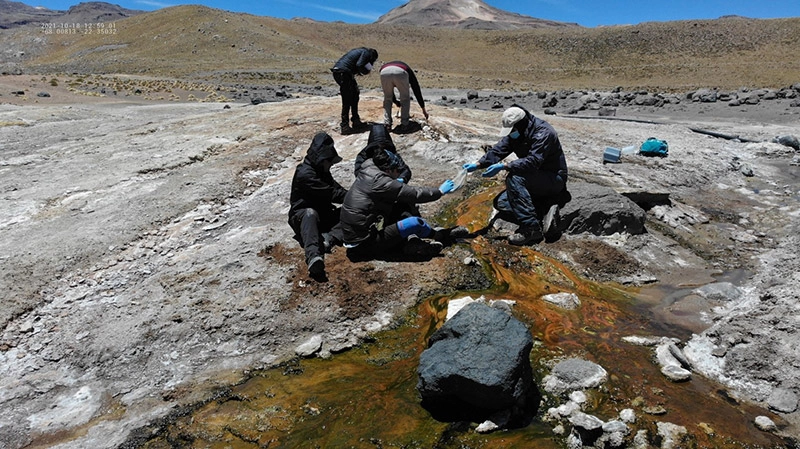
Dr. Diez and her team from the Laboratory of Microbial Ecology of Extreme Systems was not alone during the 9 days at El Tatio, she was accompanied by students and researchers, such as Simon Beard, from the Laboratory of Microbial Ecophysiology of the Science & Life Foundation, directed by Dr. Raquel Quatrini. Simon, mentioned that the microorganisms studied have a very relevant ecological role, since they participate in the cycles of elements such as carbon, nitrogen and sulfur. “This collaborative work made this trip an extremely enriching experience, with a very professional team and in a very pleasant environment, which allowed us to know and learn from the experiences of Dr. Beatriz Diez’s group on non-acidophilic thermal systems, and at the same time contribute with our own experiences and knowledge to achieve the objectives of this trip,” said Simon Beard, from the Science & Life Foundation.
In addition, the geologist of the group, Carla Barbosa Troncoso, a Master’s student from the University of Chile, directed by Dr. Diego Morata, also accompanied them for the second time in this expedition to El Tatio, where in the first trip in January 2020 she was in charge of taking water samples from the hot springs to analyze the chemistry, and now she was in charge of identifying hot springs, and measuring again physicochemical parameters, photographic record and coordinates.
This research stands out for being the first that has studied native microorganisms associated with an environment as particular as El Tatio, and it is also the first comprehensive study of viral ecology in microbial mats, which are real carpets of organisms, in this case of terrestrial hot springs.
When you visit El Tatio you will see that some geysers are painted between orange and green, and this coloration is not casual, but the result of the interaction of autotrophic organisms that use CO2 from the environment to generate organic matter, which form microbial mats not always easy to find and that hide a great diversity and biological interactions to be explored. Viruses are found right there, and they do not exist if they do not have a host organism to infect, which in these environments are mostly bacteria and archaea, which are unicellular prokaryotic organisms, some of them filamentous. A whole world to be explored, say the specialists, of which one of the components that is less known is the case of viruses: how do they work, who do they infect and how do they evolve with their hosts under these extreme conditions at high temperatures? These and other questions are being answered by researchers in the ANID_Fondecyt Regular 1190998 project directed by Dr. Díez.
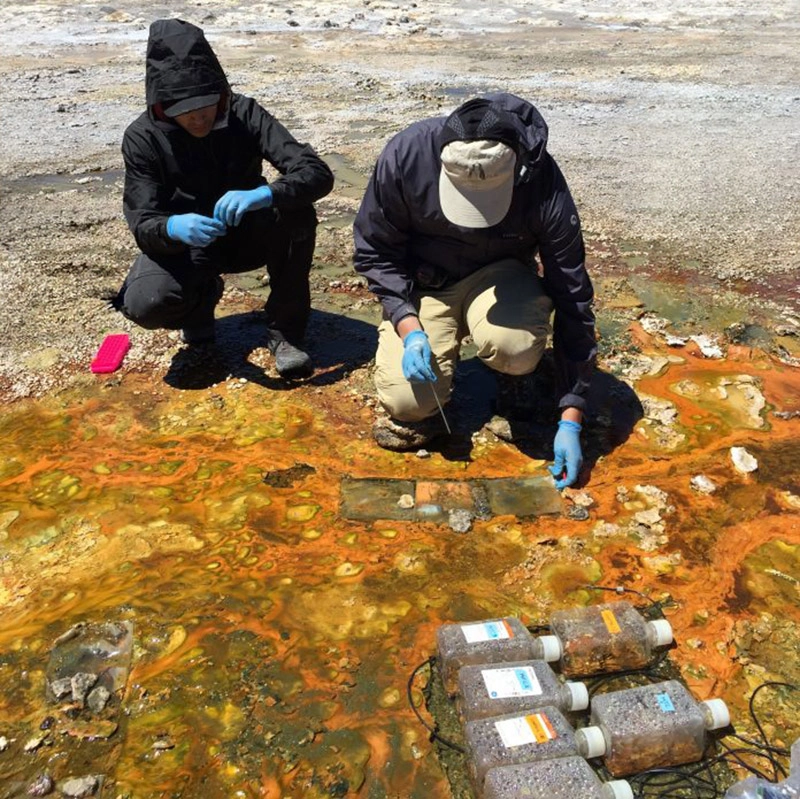
To obtain information about the viruses, the microbial mats were studied in this expedition in which students such as Felipe Loyola (Master’s degree from the University of Chile) whose tutor is Dr. Díez at the Catholic University participated. He dedicated himself, together with other students, to obtain the samples to be able to sequence all the viral genomes or metaviromas, present in more than 20 microbial mats obtained from different hot springs, and to achieve it, he says, pieces of the microbial mat were collected, then they were pressed through a 35 micron mesh to obtain the liquid that they contain and that drags the viruses with it, until filling drums that were kept in darkness.
Once in the laboratory set up in the hostel where they stayed in San Pedro de Atacama, the team prepared a filtration system based on peristaltic pumps where the interstitial liquid obtained from the squeezed mat ran through hoses that were connected to different filters to eliminate the different cell types and finally obtain the viral fraction necessary to obtain the metaviroma.
“Once all the interstitial liquid was filtered, what we did was to concentrate the viruses obtained through a flocculation (precipitation) technique using ferric chloride, where after incubating with this reagent, flocs (aggregates) of the viruses are formed, which allowed us to then filter these flocs and retain them in a filter (a small mesh of 1 μm), using the same pump filtration system. This is stored and subsequently their DNA is extracted for sequencing, and finally to analyze the viral communities using different bioinformatics tools,” explained Felipe Sepúlveda, a PhD student at Universidad Católica.
The researchers say that they want to contribute to form a repository of scientific knowledge of the area, but also cultural knowledge for Chile and the world, “which can also help the native communities to achieve better management and conservation of the park. Hopefully, at some point the El Tatio geothermal field will be named a World Heritage Site,” concluded Dr. Beatriz Diez.
You can also read the interview in its original format in Science in Chile.